The Complete UK Basketball Betting Guide for 2026
Data-backed analysis for sharper basketball bets
 Available in US
Nine years ago, I placed my first basketball bet at a high street bookmaker in London. The slip had three NBA moneylines, the odds were fractional, and I had no idea what a point spread was. I lost, obviously. But that evening — staying up past midnight to watch the fourth quarter of a game I had money on — hooked me in a way football never had. Basketball is fast, statistical, and deeply pattern-driven. For someone who likes numbers more than narratives, it was the perfect sport to bet on.
The UK basketball betting market has changed beyond recognition since then. What was once a niche corner of the sportsbook — two or three NBA markets squeezed between darts and snooker — is now a global segment valued at $8.7 billion with projections pointing toward $18.4 billion by 2033. The UK’s own online gambling sector generated GBP 7.8 billion in gross gambling yield in the year to March 2025, and basketball’s share of that pie is growing faster than most punters realise.
This guide exists because most basketball betting content aimed at UK audiences is either outdated affiliate copy recycled from 2018 or thinly disguised sportsbook advertising. I wanted to build something different — a data-backed reference that covers markets, odds formats, live betting mechanics, strategy frameworks, responsible gambling tools, and the leagues you can actually wager on from the UK. Whether you are placing your first NBA bet or refining a system you have been running for years, every section here is built to give you an edge the competition does not.
Table of Contents
- The Numbers and Moves That Shape This Guide
- How Big Is Basketball Betting in the UK and Globally
- Core Basketball Betting Markets Every UK Punter Should Know
- Decimal, Fractional, and American Odds — A Side-by-Side Breakdown
- Live Basketball Betting in the UK — Why It Dominates the Market
- Five Strategy Pillars for Profitable Basketball Bets
- What to Look for in a UKGC-Licensed Basketball Sportsbook
- Responsible Gambling Tools for UK Basketball Bettors
- NBA, EuroLeague, and Beyond — Which Leagues Can You Bet On
- Frequently Asked Questions About Basketball Betting in the UK
The Numbers and Moves That Shape This Guide
- The global basketball betting market reached $8.7 billion in 2024 and is projected to hit $18.4 billion by 2033 — this is no longer a niche segment.
- Live betting now generates over 62% of online sports betting revenue, and basketball’s structure makes it the ideal in-play sport.
- UK punters operate in one of the world’s most regulated markets: GBP 7.8 billion in online GGY, UKGC licensing as a non-negotiable baseline, and responsible gambling tools that go far beyond disclaimers.
- Five strategy pillars — bankroll management, closing line value, line movement analysis, pre-bet checklists, and emotional discipline — separate profitable bettors from the rest.
- NBA is the primary market, but EuroLeague’s expansion to 20 teams and 38 regular season games creates new value windows for UK-based bettors willing to look beyond American basketball.
How Big Is Basketball Betting in the UK and Globally
I remember a conversation with a bookmaker’s trading desk in 2019 where someone described basketball as a “rounding error” next to football. That person would not say the same thing today. Data Horizon Research now values the global basketball betting market at $8.7 billion — and projects it will more than double to $18.4 billion by 2033, growing at a compound annual rate of 8.7%. That is not a rounding error. That is a segment outpacing most traditional sports.
Basketball accounts for 15-18% of global bookmaker activity. In the United States, that figure climbs to roughly 31% of individual operator turnover — making it the second-largest betting sport after American football.
The wider sports betting industry provides the backdrop. The global market sits at approximately $125 billion in 2026 and is forecast to reach $325.71 billion by 2035, expanding at a CAGR of 11.24%. Basketball is not just riding that wave — it is one of the segments with the highest projected growth rate through 2030, according to Grand View Research analysis of the US market. The NBA alone represents a $13.92 billion market in 2026, with forecasts pushing toward $20.04 billion by 2031.
For UK-based punters, the domestic numbers tell their own story. The UK Gambling Commission reported GBP 7.8 billion in gross gambling yield for the remote (online) casino, betting, and bingo sectors in the year ending March 2025 — a 13.1% increase year on year. Roughly 290 million online bets on real events are placed every month across the UK. Basketball’s exact slice of that volume is not broken out in UKGC reporting, but every major UK-licensed operator now offers dedicated basketball sections with dozens of markets per game, a shift from the bare-bones coverage of even five years ago.
$8.7B
Global basketball betting market value in 2024
GBP 7.8B
UK online gambling GGY, year to March 2025
290M
Online bets placed monthly in the UK
Bill Miller, President and CEO of the American Gaming Association, summed up the trajectory when he noted that 2025 was another strong year for the industry but cautioned that success should never be taken for granted. That measured optimism reflects the reality: basketball betting is expanding fast, but it operates within a regulatory environment that is tightening in both the UK and the US. For punters, the opportunity is real — but so is the need to understand the market you are stepping into.
Europe holds approximately 44% of the global sports betting market, and the UK is its largest regulated hub. If you are betting on basketball from Britain, you are operating in one of the most mature, most supervised gambling ecosystems on earth. That has implications — both protective and restrictive — that run through every section of this guide.

The market is large and growing, but size alone does not help you place better bets — understanding what you can actually wager on does.
Core Basketball Betting Markets Every UK Punter Should Know
The first time I opened a basketball betting page at a UK sportsbook in 2017, there were maybe six markets per game. Today, a single NBA fixture can offer 200+ individual selections. That explosion of choice is both an opportunity and a trap — more markets means more ways to find value, but also more ways to scatter your bankroll across bets you do not fully understand. Let me walk you through the ones that actually matter.
Moneyline (Match Winner)
The simplest bet in basketball: pick the team that wins outright. No spreads, no conditions. UK sportsbooks typically list this as “match winner” with decimal or fractional odds.
Point Spread (Handicap)
The bookmaker assigns a points advantage or deficit to each team. You bet on whether the favourite wins by more than the spread, or the underdog stays within it. UK sportsbooks label this “handicap” — it is the same thing.
Totals (Over/Under)
A line is set on the total combined points in the game. You wager on whether the actual total lands over or under that number. NBA totals typically range from 210 to 240 depending on the teams involved.
Futures (Outrights)
Season-long or tournament-long bets: NBA championship winner, conference winners, MVP, season win totals. These tie up your stake for weeks or months but can offer substantial value at the right timing window.
Point spread — known as “handicap” at UK sportsbooks and “line” in American usage. All three terms describe the same market: one team receives a virtual points advantage to level the playing field for betting purposes.
Beyond these four pillars, UK sportsbooks now offer player props (individual performance markets — points, rebounds, assists), game props (first team to score, highest-scoring quarter), accumulators that combine multiple selections into a single bet, and quarter or half markets that let you bet on isolated segments of a game rather than the full 48 minutes.
Point spread example
Team A -6.5 at 1.91 | Team B +6.5 at 1.91
If you back Team A at -6.5, they need to win by 7 or more points for your bet to land. A 6-point win means Team B covers the spread and your bet loses. The half-point eliminates the possibility of a push (tie against the spread).
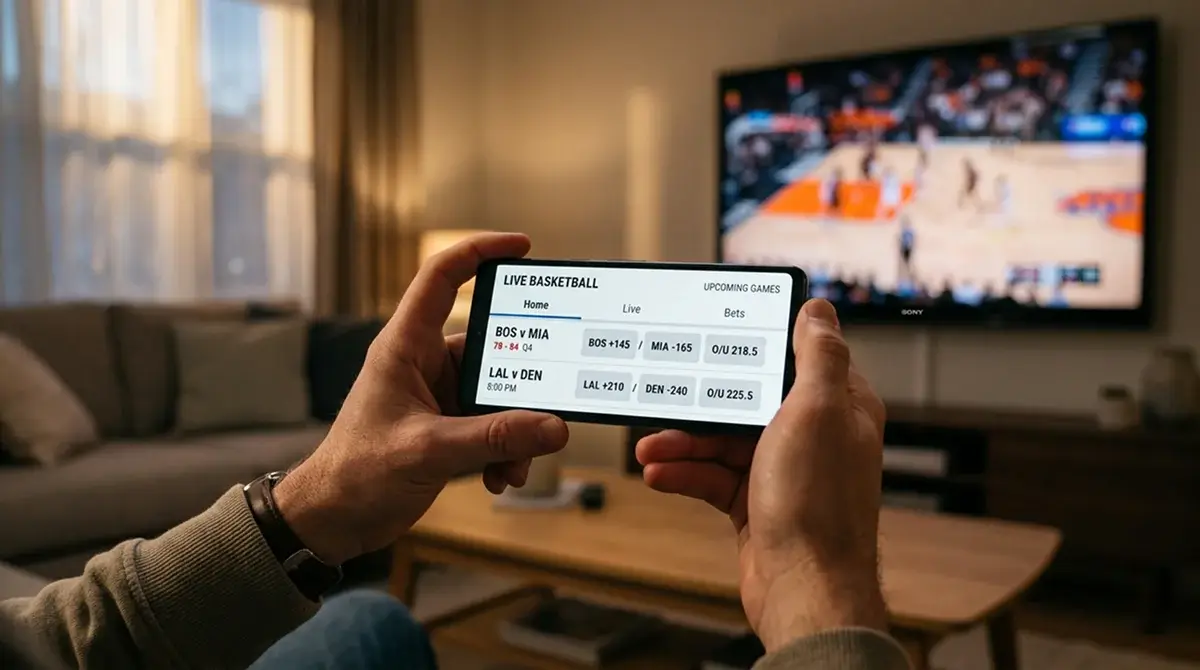
The NBA generates the deepest markets and tightest margins of any basketball league at UK sportsbooks, which is no surprise given that the league’s overall market is valued at $13.92 billion. But do not overlook the fact that every major market type listed above — moneyline, handicap, totals, props — is also available for EuroLeague games and, increasingly, for FIBA tournaments. The depth of coverage varies, but the mechanics are identical. For a detailed breakdown of each market type with worked examples and strategy notes, the basketball betting markets explained guide covers every bet type UK sportsbooks currently offer.
Accumulator (parlay) — a single bet combining two or more selections. All legs must win for the bet to pay out. UK punters call it an “acca”; American bettors say “parlay.” The mathematical principle is the same: odds multiply, and so does the bookmaker’s margin.
Knowing which markets exist is step one — understanding how the numbers beside them work is where real advantage begins.
Decimal, Fractional, and American Odds — A Side-by-Side Breakdown
A friend of mine — sharp bettor, been profitable for years — once told me he lost an entire evening’s edge because he misread American odds on a US-based stats site and calculated his implied probability wrong. Odds formats are not glamorous, but they are the language of every bet you will ever place. Get fluent or get burned.
UK sportsbooks default to either decimal or fractional odds, depending on the operator and your account settings. Most European-facing books use decimal; traditional British bookmakers still lean fractional. American odds (moneyline format) appear on US stats sites, podcasts, and social media constantly, so if you follow NBA content — and you should — you will encounter them daily.
| Format | Example | Payout on GBP 10 stake | Implied probability |
|---|---|---|---|
| Decimal | 2.50 | GBP 25.00 (GBP 15 profit) | 40.0% |
| Fractional | 3/2 | GBP 25.00 (GBP 15 profit) | 40.0% |
| American | +150 | GBP 25.00 (GBP 15 profit) | 40.0% |
All three rows above describe the same probability and the same payout. The difference is purely cosmetic — which is exactly why it trips people up. Decimal odds are the easiest to work with: multiply your stake by the odds to get total return. Fractional odds tell you profit relative to stake (3/2 means GBP 3 profit for every GBP 2 staked). American odds use a baseline of 100: positive numbers show profit on a 100-unit stake, negative numbers show how much you need to stake to win 100 units.
Converting American odds to decimal
Positive American odds (+150): Decimal = (150 / 100) + 1 = 2.50
Negative American odds (-200): Decimal = (100 / 200) + 1 = 1.50
To find implied probability from decimal odds: IP = 1 / decimal odds. So 2.50 implies 1 / 2.50 = 0.40, or 40%.
The sum of implied probabilities for all outcomes in a market will exceed 100% — that excess is the bookmaker’s margin (overround). A two-way NBA market with both sides at 1.91 implies 52.36% per side, totalling 104.72%. The 4.72% is what the bookmaker keeps.
Why does this matter beyond arithmetic? Because the national hold rate in the US climbed to approximately 10.2% in 2025, up from 9.2% in 2024 and 8.0% the year before. Bookmakers are getting better at retaining more from each pound wagered. Understanding implied probability lets you see exactly how much of your money is going to the margin before you even consider whether your pick is correct. The basketball betting odds guide dives deeper into conversion formulas, margin calculation, and how to identify value bets across UK markets.
Odds formats tell you what you are paying — live betting changes what you are paying in real time, mid-game, with no pause button.
Live Basketball Betting in the UK — Why It Dominates the Market
There is a moment in every close NBA game — usually late in the third quarter — when the trailing team makes a run, the crowd noise shifts, and the live odds swing by 30-40% in under two minutes. I have watched it happen hundreds of times, and it still creates a kind of vertigo. That volatility is exactly why live betting has become the dominant form of sports wagering globally, and basketball is the sport best built for it.
What is in-play betting? Live betting (also called in-play or real-time wagering) lets you place bets after a game has started. Odds update continuously based on the score, game clock, momentum, and other factors. Most UK sportsbooks suspend markets briefly during key moments (free throws, reviews) and reopen with adjusted prices.
The numbers behind this shift are staggering. Live betting generated 62.35% of all online sports betting revenue in 2025, and that share is growing at a compound rate of 13.62% annually. Globally, in-play bets now account for 70-75% of total wagering volume. The US market is catching up fast, moving from roughly 35-40% in-play share to around 50% by end of 2025. Basketball’s structure — four quarters, frequent scoring, natural breaks, momentum swings — makes it the ideal live betting sport. A single NBA game produces dozens of actionable moments where odds shift materially.
Mobile apps now handle approximately 78% of all online bets placed globally. For live basketball betting, the figure is likely even higher — in-play wagering almost demands a device in your hand.

Charlie Baker, the NCAA President, captured the speed of this transformation: the phone changed everything, and back in 2018 nobody was thinking about how fast the whole thing would end up in the palm of your hand. He was talking about the US college market, but the observation applies universally. In the UK, 76% of bettors aged 18-24 use mobile phones for their gambling activity, and 95% of all online gambling happens from home. Live basketball betting is, overwhelmingly, a mobile-first activity done from the sofa while watching a stream.
The strategic implications of live betting are significant enough to warrant their own deep dive. If you want to understand how live odds move, when momentum shifts create value, and how cash-out mechanics work mid-game, the live basketball betting UK guide covers timing, strategy, and the risks you need to manage when betting in real time.
Live betting rewards quick decisions — but even the fastest read is useless without a strategy framework behind it.
Five Strategy Pillars for Profitable Basketball Bets
I spent my first three years betting on basketball with no system at all. I picked games I liked, staked whatever felt right, and tracked nothing. When I finally sat down and calculated my actual results, I was down 14% over 1,200 bets. Not catastrophic — but three years of effort for a negative return. The turnaround started when I stopped treating basketball betting as entertainment with occasional winnings and started treating it as a discipline with measurable inputs and outputs.
Basketball is one of the highest-projected-growth segments in the US sports betting market through 2030, which means more money flowing into the ecosystem, tighter lines, and sharper books. Profitable betting in that environment requires structure, not hunches. Here are the five pillars I have built my approach around.
Bankroll management
Every serious bettor I know who has survived more than five years operates on a units system. One unit equals a fixed percentage of your total bankroll — typically between 1% and 3%. A GBP 1,000 bankroll at 2% per unit means GBP 20 per bet, regardless of how confident you feel. The discipline is in the consistency: no chasing losses with oversized stakes, no doubling up after a winning streak. Flat staking is the foundation; approaches like the Kelly criterion can optimise unit sizing for advanced bettors, but flat staking alone puts you ahead of most recreational punters.
Closing line value
If there is one metric that separates long-term winners from everyone else, it is closing line value — whether the odds you bet at were better than the final odds at game time. Consistently beating the closing line means you are identifying value before the market corrects. It does not guarantee profit on any single bet, but over hundreds of wagers, positive CLV is the strongest predictor of long-term profitability the industry has identified.
Line movement analysis
Lines move for two reasons: balanced action (the book adjusts to even out liability) and sharp action (informed money hits one side hard enough to shift the price). Learning to distinguish between the two — through reverse line movement, steam moves, and opening-to-closing line comparisons — gives you a window into what the sharpest bettors in the market think about a game. It is not infallible, but it is signal in a sea of noise.
Pre-bet analysis checklist
Before placing any basketball bet, I run through the same questions every time. This is not optional — it is the process that prevents impulsive decisions from eating into the edge that the first three pillars create.
Five checks before every basketball bet
- Injury report reviewed — confirmed starters, not projected lineups from eight hours ago
- Schedule context assessed — back-to-back games, travel distance, rest days for key players
- Line movement checked — has the line moved toward or away from my side since opening?
- Odds compared across at least two sportsbooks — am I getting the best available price?
- Stake sized according to bankroll rules — no unit inflation based on gut feeling
Emotional discipline
This one sounds soft, but it is the pillar that holds the other four together. Basketball offers 1,230 regular season games across the NBA alone, plus EuroLeague, FIBA, and domestic leagues. There is always another game. Chasing a loss into a midnight EuroLeague fixture you know nothing about is the fastest way to undo a month of disciplined work. I set a hard stop of three losing bets in a day — after that, the sportsbook apps come off the home screen until tomorrow.
Do
- Track every bet in a spreadsheet with odds, stake, result, and closing line
- Size stakes as a fixed percentage of your current bankroll, not your starting bankroll
- Review your results monthly and look for patterns in your losing bets
- Take breaks during losing streaks — variance is real and it ends
Don’t
- Increase stake size after losses to “get back to even”
- Bet on leagues or games you have not researched
- Ignore line movement because your initial read “feels right”
- Treat accumulators as a strategy — they are entertainment with compounded margin

Each of these pillars deserves more than a summary, and I have given them exactly that. The basketball betting strategies guide breaks down bankroll systems, closing line value tracking, and line movement analysis with worked calculations and seasonal examples.
Closing line value is the single strongest predictor of long-term profit the industry has found: if the price you took beats the de-margined closing line, you were ahead of the market. The „other side” is used to strip the bookmaker’s overround from the close, so the no-vig CLV is a cleaner read than comparing raw prices. One bet proves nothing — but consistent positive no-vig CLV across a season is the signal you are betting +EV, whatever the short-term results. Informational only.
Every leg carries the bookmaker’s margin, and on an accumulator those margins multiply. A four-leg acca at 1.90 pays around 13.03, but the compounded hold climbs to roughly 18–19% — versus about 5% on a single. That is why accas are entertainment, not a strategy: the more legs you add, the harder the maths works against you. Enter each leg’s true (no-vig) win probability to see whether the payout actually covers that stacked margin. Informational only.
Strategy tells you how to bet — but where you bet matters just as much, and in the UK, that starts with a three-letter acronym.
What to Look for in a UKGC-Licensed Basketball Sportsbook
I once had a conversation with a bettor who had deposited GBP 500 into an offshore sportsbook because their NBA odds were "two ticks better" than any UK-licensed operator. When he tried to withdraw his winnings three weeks later, the account was locked, customer support stopped responding, and the money was gone. Two ticks of value on a bet slip are worth precisely nothing if the operator holding your funds has no legal obligation to return them.
Non-negotiable: UKGC licensing — Any sportsbook you use for basketball betting in the UK must hold an active licence from the UK Gambling Commission. This is not a preference. It is the legal baseline. Operating without one is a criminal offence under the Gambling Act 2005, and betting with an unlicensed operator means you have zero regulatory protection if something goes wrong.
The UK currently has 5,825 licensed betting premises (a 1.8% decline year on year), but the real action is online — and UKGC oversight is where your protections live. A UKGC licence means the operator is subject to mandatory segregation of customer funds, fair terms and conditions auditing, complaint escalation to an independent Alternative Dispute Resolution provider, and compliance with responsible gambling requirements including self-exclusion through GAMSTOP.
The Gambling Commission is not passive about enforcement. Tim Miller, the UKGC's Executive Director, revealed that the Commission issued 741 cease-and-desist orders and blocked or removed 266,667 illegal URLs in the 2025-2026 period, backed by GBP 26 million in additional funding over three years to combat unlicensed gambling. That enforcement activity is your safety net. An unlicensed operator sits outside it entirely.
| Criteria | What to look for | Why it matters for basketball |
|---|---|---|
| Licence status | Active UKGC licence number, verifiable on the Commission's public register | Legal protection, fund segregation, dispute resolution |
| Basketball market depth | 50+ markets per NBA game, including player props and quarter markets | More markets means more opportunities to find value |
| Live betting speed | Fast market suspension and reopening during game breaks, minimal latency on mobile | Basketball in-play betting demands real-time responsiveness |
| Odds competitiveness | Margins under 5% on main NBA markets, checked against at least one competitor | Lower margin means more of your winning bets translate to actual profit |
| Responsible gambling tools | Deposit limits, reality checks, session timers, GAMSTOP integration | Essential for maintaining control over live betting sessions |
No single operator will be best across every criterion. The practical approach is to hold accounts at two or three UKGC-licensed sportsbooks so you can compare odds on each game and place your bet where the price is best. This is line shopping, and over a full NBA season of 1,230 regular-season games, even small improvements in average odds compound into a meaningful difference to your bottom line.
A UKGC licence protects your funds — the responsible gambling tools that come with it protect something more important.
Responsible Gambling Tools for UK Basketball Bettors
Let me be direct about something that most basketball betting guides either skip entirely or bury in a boilerplate disclaimer at the bottom of the page. Gambling harm is real, it is measurable, and it is more widespread than the industry likes to admit. A Pew Research survey found that 43% of Americans now believe legal sports betting is bad for society — up from 34% in 2022. Among men under 30, the group most likely to bet on basketball, that figure jumped from 22% to 47% in three years. These are not abstract numbers. They reflect millions of people whose relationship with betting has moved from entertainment to problem.
Academic research published in the Journal of Financial Economics found a substantial increase in bankruptcy rates, debt sent to collections, and auto loan delinquencies in US states that legalised online sports betting — with the effects appearing roughly two years after legalisation. The researchers concluded that the ease of access to sports gambling is harming consumer financial health. The UK, where online betting has been legal and widely available for much longer, has its own patterns of harm that UKGC data tracks but that individual punters rarely see unless they look.
GAMSTOP and self-exclusion — GAMSTOP is the UK's national self-exclusion scheme for online gambling. Registering blocks you from all UKGC-licensed gambling websites and apps for a minimum of six months. It is free, confidential, and cannot be reversed until the exclusion period ends. If you find yourself betting more than you planned, chasing losses, or hiding your gambling activity from people close to you, GAMSTOP is designed exactly for that moment.
Beyond self-exclusion, every UKGC-licensed sportsbook is required to offer deposit limits (daily, weekly, or monthly caps you set yourself), reality checks (pop-up reminders of how long you have been in a session and how much you have spent), cooling-off periods (temporary breaks of 24 hours to six weeks), and session time limits. These tools are not decorative. I use deposit limits myself — not because I have a gambling problem, but because the structure removes the decision from the moment of impulse and puts it back in a calm, rational context.
Financial Risk Assessments (FRA) — The UKGC has been piloting a framework that allows operators to assess financial vulnerability without requiring customers to submit bank statements. Tim Miller, the Commission's Executive Director, has been vocal that the current approach — where some operators ask consumers to share bank statements and other financial documentation — is outdated, inconsistent, and disproportionate. The FRA pilot aims to replace that with lighter-touch, data-driven checks. This is still evolving, but it signals the direction of UK regulation.
If any part of this section resonates with your own experience — if you recognise patterns of escalation, secrecy, or financial strain — the tools exist and they work. GamCare (0808 8020 133) and the National Gambling Helpline are free, confidential, and staffed by people who understand exactly what you are dealing with.
With the regulatory framework clear, the next question is practical: which basketball leagues can you actually bet on from the UK?
NBA, EuroLeague, and Beyond — Which Leagues Can You Bet On
When most UK punters think "basketball betting," they think NBA — and for good reason. The NBA is the deepest, most liquid basketball betting market on earth. Its new $77 billion domestic media rights cycle, which started in the 2025-26 season, has injected even more visibility and data coverage into the league, which in turn drives tighter odds and more market options at UK sportsbooks. If you are going to bet on one basketball league, the NBA is the obvious starting point.
But it is not the only option, and I would argue it is not always the best one.
NBA
82-game regular season per team, October to April. Playoffs run April through June. Deepest markets, tightest margins, most data available. Games start between 23:00 and 03:30 UK time.
EuroLeague
Expanded to 20 teams in 2025-26, each playing 38 regular season matches — more games and more betting windows than previous formats. Games tip off in early evening UK time, a significant practical advantage.
BBL (British Basketball League)
The UK's top domestic league. Limited market coverage at most sportsbooks, but available at larger operators. Smaller sample sizes and less data mean more volatility — and potentially more pricing inefficiency.
FIBA Tournaments
World Cup, EuroBasket, Olympic basketball. International windows create intense, short-burst betting events with unique dynamics — national team form differs sharply from club form.

The EuroLeague expansion is particularly interesting for UK bettors. Twenty teams playing 38 regular season matches each means a significantly larger fixture list than before, with games scheduled on Tuesdays, Wednesdays, Thursdays, and Fridays — often overlapping with domestic league commitments. That scheduling pressure creates fatigue and rotation patterns that sharp bettors can exploit, especially when a top EuroLeague club has a domestic league game 48 hours before or after a European fixture. The NBA betting UK guide covers the NBA's specific structure, schedule factors, and time zone considerations in detail.
FIBA tournaments and the BBL occupy a different part of the spectrum. Market coverage is thinner, odds are wider, and the data infrastructure is less developed. That cuts both ways: less information for you also means less information for the bookmaker's traders. If you have genuine knowledge of, say, BBL team form or FIBA qualifying group dynamics, you may find pricing gaps that simply do not exist in NBA markets. The trade-off is lower liquidity — your maximum stake will be smaller, and your bet may move the line.
For the majority of UK-based basketball bettors, the practical approach is to anchor on the NBA as your primary market — deepest data, tightest odds, most coverage — and treat EuroLeague as a complementary market where scheduling edges and lower public interest create occasional value. FIBA and BBL are worth monitoring if you have specific expertise, but they are specialist plays, not staples.
Frequently Asked Questions About Basketball Betting in the UK
Is basketball betting legal in the UK?
Yes. Basketball betting is fully legal in the United Kingdom when conducted through operators licensed by the UK Gambling Commission (UKGC). The Gambling Act 2005 regulates all forms of commercial gambling in the UK, and any sportsbook offering basketball markets to UK residents must hold an active UKGC licence. Betting with unlicensed operators is not illegal for the individual punter, but it strips away all regulatory protections — fund segregation, dispute resolution, responsible gambling tools — that make UK-licensed betting comparatively safe. Always verify an operator's licence status on the UKGC's public register before depositing.
What are the most popular basketball betting markets?
The four core markets are moneyline (match winner), point spread (handicap), totals (over/under), and futures (outright winners for championships, awards, or season win totals). Beyond these, UK sportsbooks offer player props (individual performance bets on points, rebounds, assists), game props (first team to score, highest-scoring quarter), accumulators (multiple selections combined into one bet), and quarter or half markets. NBA games at major UK sportsbooks typically offer 100-200+ individual markets per fixture, while EuroLeague games offer a smaller but still substantial selection.
How do basketball betting odds work in decimal and fractional formats?
Decimal odds show your total return per unit staked — odds of 2.50 mean GBP 25 back on a GBP 10 bet (GBP 15 profit plus your GBP 10 stake). Fractional odds show profit relative to stake — 3/2 means GBP 3 profit for every GBP 2 wagered. Both formats express the same underlying probability; the arithmetic just differs. To convert fractional to decimal, divide the first number by the second and add 1: 3/2 becomes (3 divided by 2) + 1 = 2.50. To find implied probability from decimal odds, divide 1 by the decimal: 1 / 2.50 = 0.40, or 40%. Most UK sportsbooks let you toggle between formats in your account settings.
What is point spread betting in basketball?
Point spread betting (called handicap betting at UK sportsbooks) levels the playing field between unevenly matched teams by assigning a virtual points advantage or deficit. If a team is listed at -7.5, they need to win by 8 or more points for a spread bet on them to pay out. If the opponent is at +7.5, they can lose by up to 7 points and still "cover" the spread. The half-point eliminates ties (pushes). Point spread betting is the most popular NBA market globally because it creates a roughly 50/50 proposition on every game, regardless of how lopsided the actual matchup is.
Can I bet on basketball live and in-play in the UK?
Yes, and it is the fastest-growing segment of the market. Every major UKGC-licensed sportsbook offers live betting on NBA games and most EuroLeague fixtures. Live markets include updated moneylines, spreads, totals, and quarter-specific bets, with odds recalculating in real time based on score, game clock, and momentum. Live betting accounted for 62.35% of online sports betting revenue in 2025. Basketball's high-scoring, fast-paced structure makes it particularly well suited to in-play wagering, but the speed also increases the risk of impulsive betting — setting session limits before tip-off is a sensible precaution.
What is a basketball accumulator and how does it work?
An accumulator (acca) combines two or more individual selections into a single bet. All legs must win for the bet to pay out. The odds multiply across each leg, which creates the appeal — a four-leg acca at 1.90 per leg pays approximately 13.03 to 1. The catch is that the bookmaker's margin also multiplies with each added leg. On a single bet with a 5% margin, the book's edge is manageable. On a four-leg acca, that edge compounds to roughly 18-19%. Accumulators are popular but mathematically unfavourable compared to singles — treat them as occasional entertainment, not as a core strategy.
How do I choose a reliable UKGC-licensed basketball betting site?
Start with the non-negotiable: an active UKGC licence, verifiable on the Gambling Commission's public register. Beyond that, evaluate basketball market depth (how many markets per NBA game), odds competitiveness (compare the same market across two or three operators), live betting functionality (speed, market availability, mobile performance), and responsible gambling tools (deposit limits, reality checks, GAMSTOP integration). Holding accounts at two or three UKGC-licensed sportsbooks allows you to line shop — comparing odds and placing each bet where the price is best — which is one of the simplest ways to improve long-term returns.
Created by the ”Basketball Betting Guide” editorial team.